


Lesson 2.1.6
Not Found is not empty: the filter mistake that costs the most
What this costs
Free. This lesson saves credits rather than spending them.
Before you start
A column with some blank cells in it.
Three different things look identical in the table and mean completely opposite things. A cell the tool never ran on. A cell the tool ran on and found nothing. A cell the tool ran on and returned an empty value for. Filtering on "is empty" treats all three as the same, and that is where the money goes.
The three states
| State | What happened | What it costs | What to do |
|---|---|---|---|
| Skipped | The tool never ran. A filter or condition excluded the row, or a required input was missing | Nothing | Fix the input or widen the condition, then run it |
| Not found | The tool ran and genuinely found nothing | Nothing on a charged on success tool | Accept it, or try a different tool. Re running the same tool changes nothing |
| Returned empty | The tool ran, concluded, and the answer is legitimately blank | You were charged | Treat it as an answer, not a failure |
How to tell them apart

- 1Thirty six percent, in green, red and amber. Completion, rejections and skips, in one bar.
- 2Skipped. The tool never ran here, so nothing was charged and nothing was missed.
- 3The reason: this row is B2C, and the condition asked for B2B.
- 1
Open the cell rather than reading the table
The detail view distinguishes a row the tool never touched from one it processed. This is the whole diagnosis, and it takes ten seconds.
- 2
Check the condition on the column
If the column has a condition, work out how many rows it excluded. Those are your skips, and they are almost always the biggest group.
- 3
Check the required input
Most skips are a missing dependency rather than a deliberate condition. A people tool with no website. A domain tool with no company name. Fix the input column and the skips resolve themselves.
- 4
Filter on the tool status field, not on the value
Where a tool exposes a status or match type, filter on that. It is the only filter that distinguishes the three states reliably.
What to do with each group
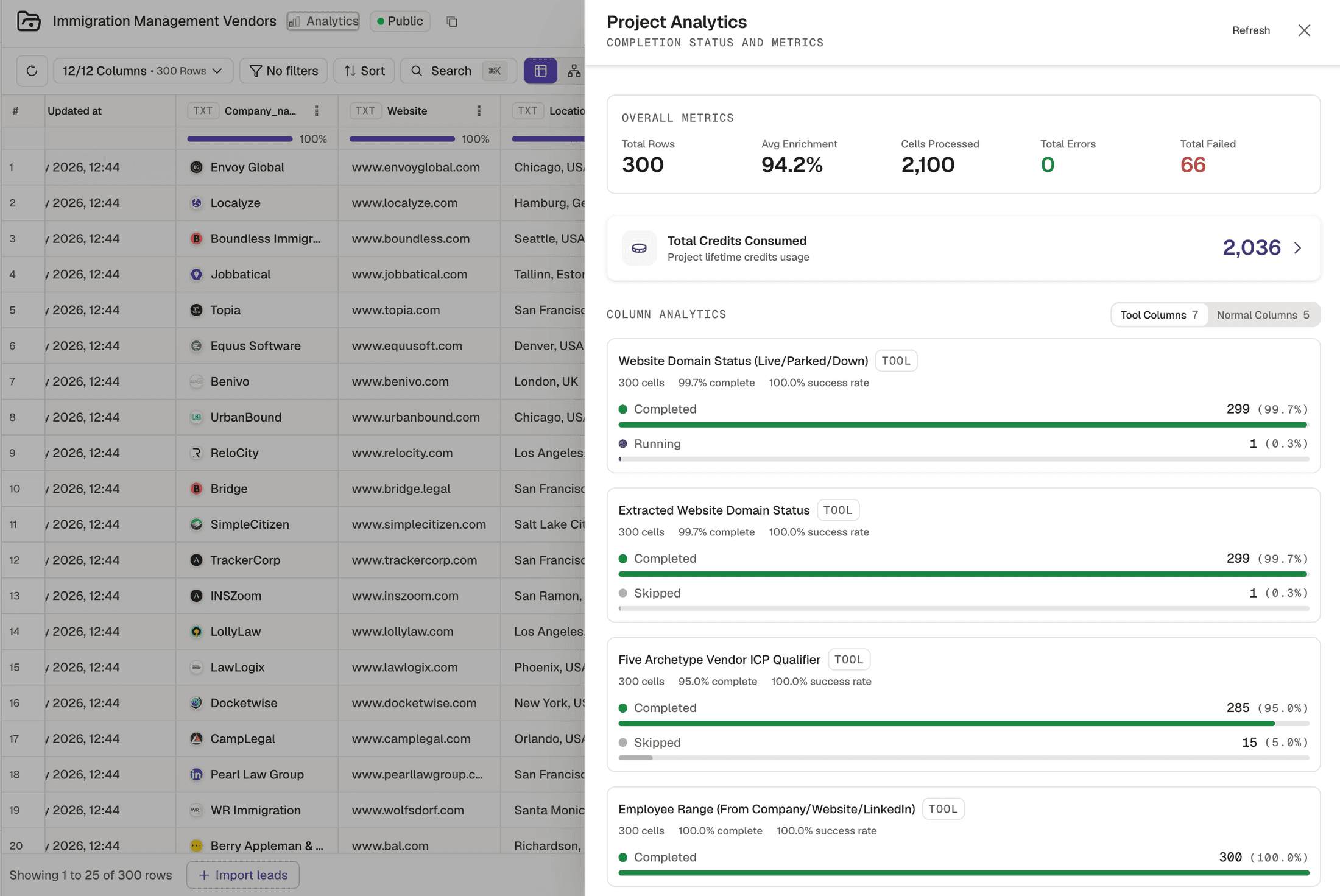
- 1Completed. The tool ran and returned a value. 299 of 300.
- 2Running. Still working. A dependent column reading this now is the race from lesson 2.1.7.
- 3Skipped. The tool never ran on these 15 rows, so they cost nothing and re running the column will not fix them.
- 4Total Failed is a fourth thing again: the tool ran and errored. That is the number worth a targeted re run.
Worked example · A people column with 400 blank cells, diagnosed
| Group | Rows | Cause | Action | Cost to fix |
|---|---|---|---|---|
| Skipped | 265 | No website on the row | Run Website Finder, then re run people on those rows only | 530 plus the people run |
| Not found | 118 | Tool ran, no person matched | Loosen the role description or accept | 0, misses are free |
| Returned empty | 17 | Matched a company with no public contact | Accept. This is an answer | 0, do not re run |
Without this diagnosis you would have re run 400 rows. With it, you fix 265 properly, adjust the approach on 118, and leave 17 alone. Same outcome, and you know which of your three problems is actually a problem.
Filtered on "is empty" and re ran everything
- What you see
- Repeat spend on rows that will always be blank
- The fix
- Diagnose first. The three states need three different responses.
Concluded the tool has poor coverage
- What you see
- A support ticket about data quality
- The fix
- Check how many of the blanks are skips. On a list with missing websites this is usually most of them.
Kept re running to fix a not found
- What you see
- Same blank result, every time
- The fix
- A not found is a real answer. Change the approach or the tool, not the number of attempts.
Check yourself
0 of 3 answered1.Which of the three blank states costs you money if you re run it?
2.Your people column shows 400 blanks. What is usually the biggest group?
3.Where can you see completed, running and skipped counted per column?
Try it yourself
Take your worst performing column. Count the blanks, then sort them into skipped, not found and returned empty. Write the three numbers down.
- You have done it when
- The three numbers add up to your blank count, and you have a different planned action for each group.
- Credit budget
- Free.