


Lesson 3.1.1
Schedule a column, schedule a builder, and get notified
What this costs
Free to configure. The runs cost what the runs cost.
Before you start
A workflow you have already run manually at least twice.
There are two different things you can put on a schedule and people confuse them. A builder on a schedule brings in new companies. A column on a schedule refreshes data on companies you already have. They have different costs and different failure modes.
| Scheduled builder | Scheduled column | |
|---|---|---|
| Brings you | New rows | Fresh values on existing rows |
| Cost grows with | How much the source changes | How many rows you already have |
| Main risk | Duplicates and re enriching known companies | Paying repeatedly to confirm nothing changed |
| Control it with | Suppression and existing company checks | Conditions, and a slower cadence |
- 1
Automate a workflow you have run manually twice
Never schedule something you have not watched work. An automation multiplies whatever it was already doing, including the mistakes.
- 2
Match the cadence to how fast the source actually changes
Job postings weekly. A trade association member list quarterly. A permit portal weekly. Refreshing faster than the source changes is pure cost.
- 3
Put conditions on every paid column before scheduling
A condition is enforced on every future run. A filter is not. This is the difference between an automation and a runaway bill.
- 4
Send a notification when the run finishes
A webhook into Slack telling you how many new rows arrived. Without it, an automation that silently stopped looks identical to a market that went quiet.
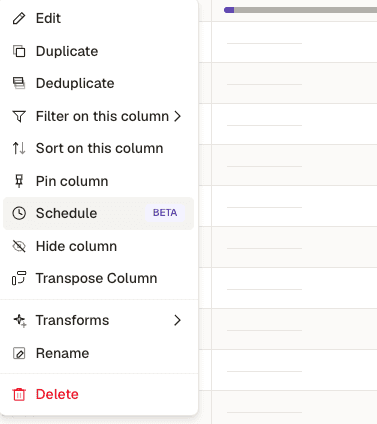
- 1Schedule, on the column you want to keep current.
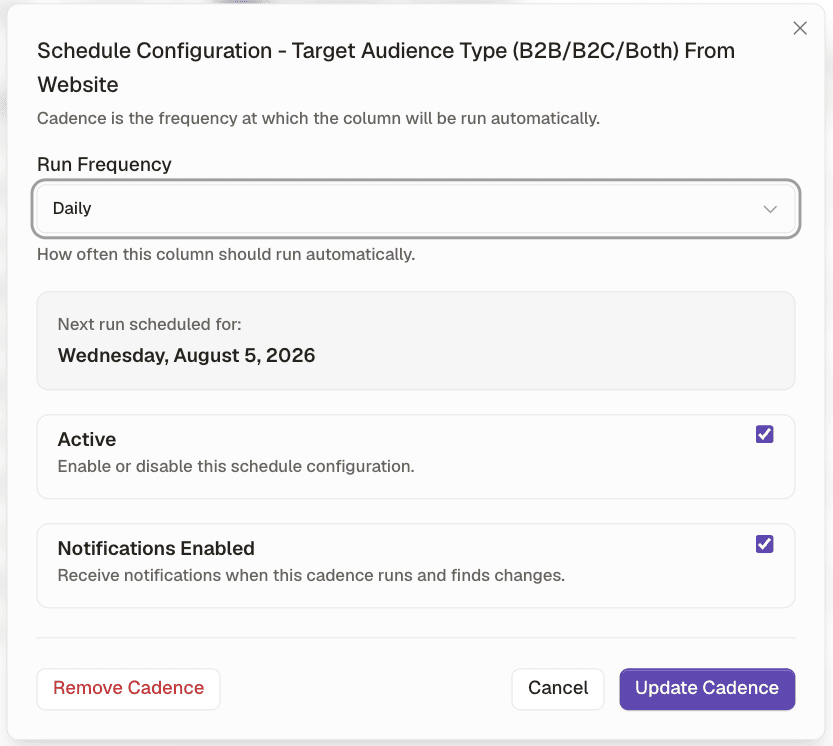
- 1Run frequency. Daily on a job board, quarterly on a member directory.
- 2The next run, stated plainly, so an automation is never a black box.
- 3Notifications when the cadence runs and finds changes. Without this, a stopped automation looks identical to a quiet market.
Check yourself
0 of 3 answered1.What is the difference between scheduling a builder and scheduling a column?
2.How should you pick the cadence?
3.What should you never schedule?
Related and next
This lesson is written and complete. Its screen recording is still to come, and the written walkthrough is designed to stand on its own without one.