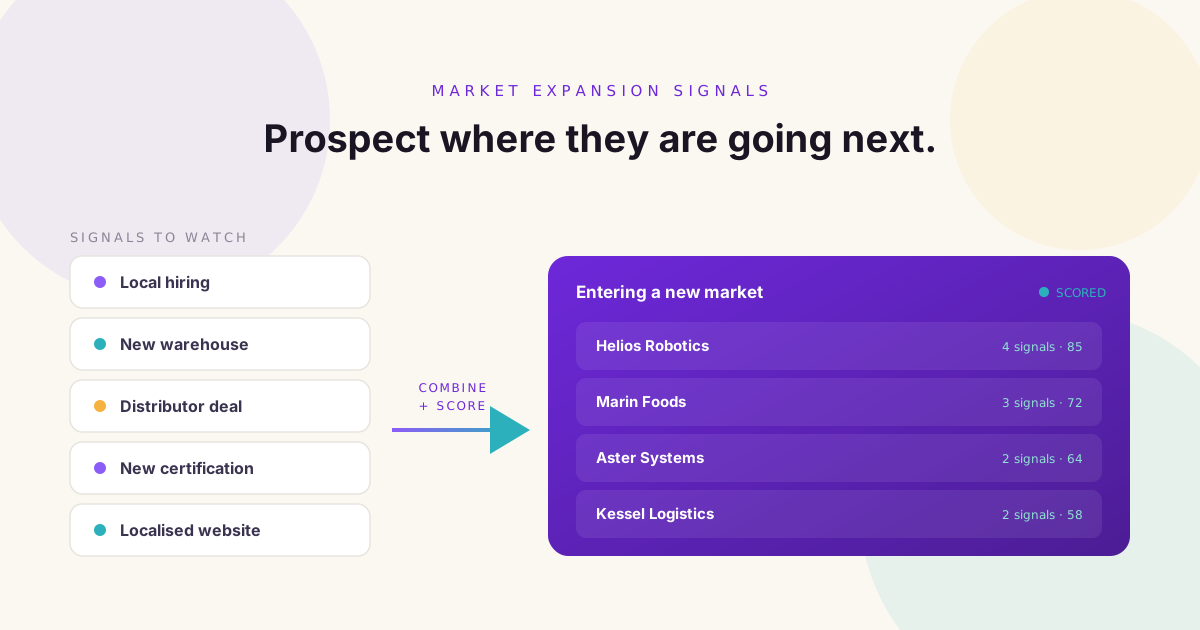
A company entering a new market has a problem. It needs to figure things out. New customers. New suppliers. New distributors. New employees. New regulations. New technology. New partners.
All of those problems can create opportunities for B2B vendors. The challenge is finding those companies before the expansion becomes obvious.
Most sales teams approach international prospecting from the other direction. They choose a country, open a database, filter companies by industry and size, and start prospecting. For example: 'Show me manufacturing companies in Germany with 200+ employees.' That is a reasonable starting point.
But there is another question that is often much more valuable: 'Which companies are currently trying to enter Germany?'
Those are two very different prospecting lists. One contains companies that happen to exist in a market. The other contains companies that may have a new reason to buy something. That distinction sits at the heart of signal based prospecting.
Why Market Expansion Is Such a Valuable Sales Signal
International expansion is not a single event. It is a chain of activities. A company may start by researching a market. Then it might:
- Hire local employees
- Open an office
- Find distributors
- Attend local trade shows
- Register products
- Obtain certifications
- Build partnerships
- Establish a local entity
- Open a warehouse
- Launch a localised website
Each event can reveal something about the company's strategy. And each event can potentially become a prospecting signal.
For example, imagine a US manufacturer begins hiring salespeople in France. That does not automatically mean the company needs your product. But it tells you something important: France has become strategically relevant to the company. If you sell services or technology that help businesses enter new markets, that signal could make the company worth researching.
Do Not Just Find Companies in a Market
This is where international prospecting often goes wrong. Say you are selling logistics software to companies expanding into Southeast Asia. You could build a list of 10,000 companies already operating in Singapore, Malaysia, Thailand, Vietnam, and Indonesia. But you are competing for their attention alongside every other vendor targeting those markets.
Instead, consider building a list of companies that are entering those markets. Your criteria might look like:
- European manufacturer
- 100+ employees
- Recently announced Southeast Asian expansion
- Hiring locally
- Attending regional trade shows
- Looking for distributors
- Recently received relevant certifications
Suddenly your prospect list is not just based on geography. It is based on business activity. That is a much more interesting dataset.
What Does a Market Expansion Signal Look Like?
Expansion signals come in many forms. Some are obvious. Others are easy to miss. Here are some of the most useful ones.
1. New Office Openings
A new office is one of the clearest expansion indicators. Companies do not usually establish a physical presence in another country without a reason. A new office could indicate new sales activity, customer growth, local hiring, distribution operations, a regional headquarters, or customer support expansion.
For prospecting purposes, the important information is not simply 'Company X has an office in Spain.' It is 'Company X recently opened an office in Spain.' The second piece of information has timing.
2. Hiring in a New Country
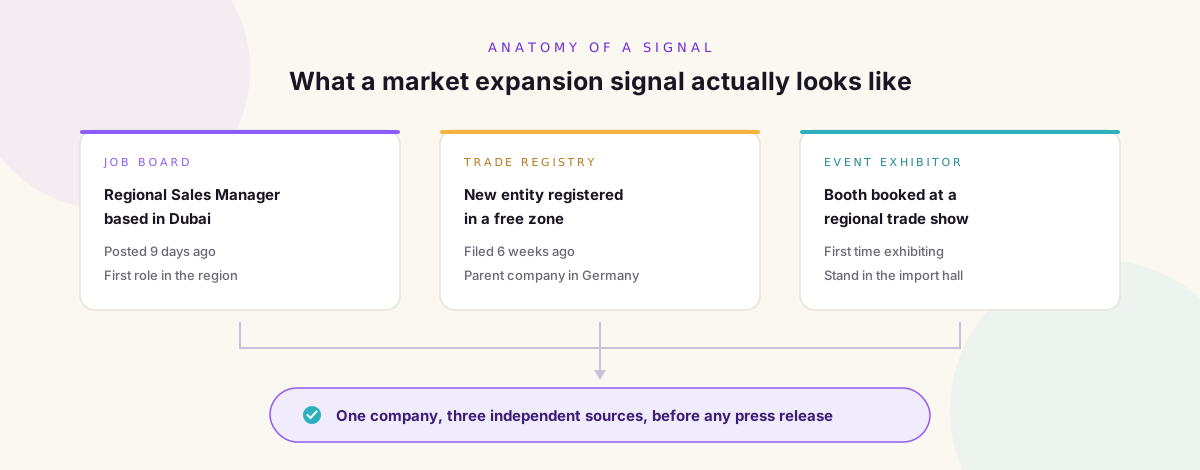
Job postings can reveal expansion before a company makes a major public announcement. Imagine a company that historically operates in the UK. Then you notice several new vacancies in France: Country Manager, Sales Development Representative, Account Executive, Operations Manager.
That hiring activity can be an early indication that the company is building a presence in France. This is particularly useful because hiring signals may appear before other expansion signals. A company may not announce a new regional strategy publicly. But it still needs people.
3. International Trade Shows
Trade shows are another valuable expansion signal. If a company begins exhibiting at events in a new region, it may be looking for customers, distributors, partners, suppliers, investors, or market visibility.
For example, a company that traditionally attends European trade shows but suddenly appears at an Asian industry exhibition has given you a useful piece of information. The company is putting resources into that market. That does not guarantee buying intent. But it provides context that a standard company database may not capture.
4. Distributor and Partnership Announcements
Companies entering new markets do not always establish their own offices. Sometimes they work through local partners. Announcements such as 'Company X partners with Y to expand distribution across the Middle East' can be powerful prospecting signals. They indicate that the company is actively building a commercial presence. For vendors serving expanding companies, this can be a strong trigger for research.
5. New Certifications
Certifications can reveal international ambitions. A company obtaining a certification relevant to a new market may be preparing to sell products there. Depending on the industry, businesses may pursue certifications or registrations required to operate in specific markets.
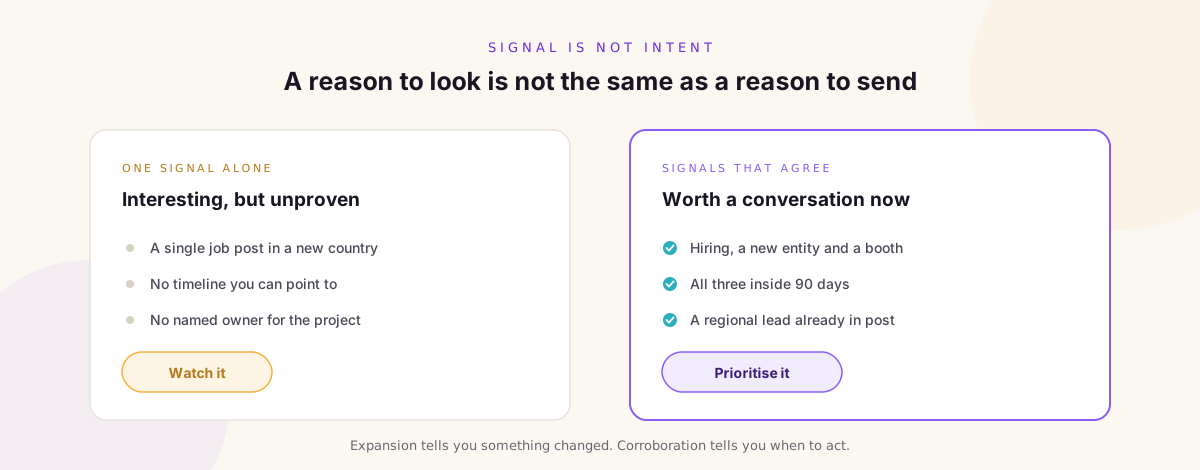
The certification itself is not proof of expansion. But when combined with other signals it becomes much more interesting. Consider a new certification plus local hiring plus trade show participation. That is a stronger expansion story than any one signal alone.
6. New Localised Websites
This is one of the easier signals to overlook. A company may launch a French website, a German version, a Japanese landing page, a localised pricing page, or a regional domain. Localisation requires investment. It may indicate that the company wants to attract customers in a specific market. Again, it is not proof of immediate purchasing intent. But it is useful context.
7. New Facilities or Warehouses
Physical infrastructure is another major signal. A company opening a warehouse, manufacturing facility, distribution centre, regional office, or research facility may be committing significant resources to a new market.
For certain B2B products this can be particularly valuable. A new warehouse might matter to logistics providers, warehouse automation companies, security providers, ERP vendors, workforce management platforms, and industrial equipment suppliers. The signal becomes powerful when you connect it to your ICP.
8. Import and Export Activity
For manufacturers and physical product businesses, international trade activity can provide another useful source of information. A company beginning to export into a new country may be entering that market commercially. Likewise, changing supplier relationships or import activity can reveal shifts in operations. Trade data does not explain everything. But it can provide another layer of evidence when combined with company research.
9. New Product Launches
Sometimes expansion starts with the product rather than the office. A company may launch a product designed for a new country, a new industry, a new regulatory environment, or a new customer segment. That can indicate a broader go to market strategy.
For sales teams, the important question becomes: what does this launch require the company to do next? Perhaps it needs new distributors. Perhaps it needs local marketing. Perhaps it needs compliance support. Perhaps it needs additional infrastructure. That is where prospecting opportunities begin to appear.
10. Funding for Expansion
Funding can also create expansion opportunities. A company that raises capital may use it to enter new markets, hire employees, open offices, expand production, build sales teams, or launch products.
The funding announcement itself is not necessarily the buying signal. The important part is understanding what the company intends to do with the money. If the company says it plans to use the funding to expand across Europe, that is far more relevant to a European market entry service than simply knowing it raised money.
The Real Advantage: Combining Signals
One signal is useful. Several related signals can be much more powerful. Consider a software company that has opened a German office, hired a German sales team, launched a German website, and started attending German industry events.
Individually, each event provides some information. Together they tell a much clearer story: the company is actively building its German presence. That is the kind of prospecting context that can make outreach more relevant.
Build an Expansion Signal Score
You do not need a complicated algorithm. A simple scoring system can help your team prioritise accounts. For example:
- New country hiring: +20
- New office: +25
- New facility: +25
- Regional trade show: +15
- New distributor: +15
- Market specific certification: +15
- Localised website: +10
You can then add ICP fit on top: strong ICP fit +30, relevant expansion signal +20, multiple recent signals +20. A company with a high combined score becomes a priority for further research. The exact scoring system should be tailored to your business. There is no magic number.
Where Can You Find Expansion Signals?
The information is often publicly available, but it is scattered. Useful sources include:
- Company websites: news, press releases, locations, careers, partnerships, investor updates
- Job boards: clusters of hiring in previously inactive countries
- Trade shows: exhibitor lists, speaker lists, sponsors, event participation
- Government registries: new company registrations, local entities, business activity
- Industry associations: member information, expansion announcements, industry news
- Certification directories: businesses meeting specific regulatory or industry requirements
- Procurement platforms: new contracts and tenders that indicate activity in a new market
- Business news: announcements that provide context around expansion plans
The challenge is not necessarily finding one source. It is connecting the information across sources.
Why This Is Difficult to Do Manually
Imagine researching 500 companies. For each company you want to know whether it operates internationally, whether it has entered a new country, whether it is hiring there, whether it has a new facility, whether it is exhibiting at regional events, whether it has obtained relevant certifications, and whether it has a local partner.
Doing this manually can take an enormous amount of time. You could search each company individually. Then check job pages. Then search event websites. Then review announcements. Then update your spreadsheet. By the time you have finished, some of the information may already have changed. This is where AI assisted prospecting becomes useful.
How AI Can Help Identify Expansion Opportunities
AI can help sales teams process large amounts of scattered information. Depending on the workflow, AI can help:
- Discover relevant companies
- Search multiple data sources
- Extract company information
- Identify geographic signals
- Detect hiring patterns
- Analyse announcements
- Organise expansion data
- Enrich company records
- Identify decision makers
- Prioritise accounts
The important point is that AI is not replacing the strategy. It is helping make the strategy scalable. Instead of manually investigating every company, your team can create rules around the signals that matter.
Turn Expansion Signals Into a Prospecting Workflow
Here is a simple workflow you can use.
- Define the target market. Choose the country or region you want to target.
- Define the ICP. Determine which industries, company sizes, and business models are relevant.
- Define expansion signals. Choose the events that indicate market entry.
- Find companies showing those signals using relevant public and industry data sources.
- Enrich the companies. Add company information and relevant contacts.
- Score the opportunities. Prioritise based on ICP fit and signal strength.
- Research before outreach. Understand what the expansion actually means for the company.
- Build the outreach around the context. Explain why that expansion might make your solution relevant.
Example: Finding Companies Entering the Middle East
Imagine you are selling services to companies entering the Middle East. A generic strategy might be to find companies headquartered in Europe. That is far too broad.
A signal driven strategy might be to find European companies that recently started hiring in the UAE or Saudi Arabia, are exhibiting at regional trade shows, and have announced distributor partnerships. Now you have a much more targeted prospect pool.
The outreach can also be more relevant. Instead of 'We help European companies grow internationally', you might say: 'I noticed your team has started building a presence in Saudi Arabia. Companies making that transition often need to establish local partnerships and infrastructure before the market becomes fully operational.' That is a conversation starter, not a generic pitch.
Do Not Mistake Expansion for Intent
There is an important distinction here. A company expanding into a new market is not automatically looking for your product. Expansion is a signal, not a guarantee. That means sales teams should avoid making unsupported assumptions.
Instead of 'You are expanding into Germany, so you need our software', use: 'I noticed your team has recently expanded into Germany. I am curious whether [specific problem] is becoming more relevant as that operation grows.' The difference matters. Good prospecting creates a reason to start a conversation. It does not pretend to know the prospect's needs.
Why Expansion Signals Can Beat Traditional Lead Filters
Traditional filters tell you what a company is. Signals tell you what a company is doing. That difference is significant.
A company may have 500 employees, $100 million in revenue, the right industry, and the right location, and still have no reason to talk to you right now. Another company might have 150 employees, the right industry, a recent expansion, new local hiring, and a new facility. The second company may be a much more interesting account. That is why modern prospecting increasingly combines firmographic data with business signals.
How Kuration AI Fits Into Expansion Based Prospecting
Kuration AI helps revenue teams discover companies using more than traditional database filters. Teams can build custom prospect databases around specific markets, industries, and business characteristics.
That can include information discovered through trade shows, government sources, certifications, supplier directories, Google Maps, company websites, public business information, and other specialised sources.
The result is a prospecting workflow designed around the question that matters: which companies are actually relevant to what we are selling? When expansion signals are added to that process, sales teams can prioritise companies based not only on who they are, but on what they are doing.
Frequently Asked Questions
How do I find companies expanding internationally?
Look for signals such as new offices, local hiring, distributor partnerships, trade show participation, certifications, new facilities, localised websites, and public expansion announcements.
Are hiring signals useful for finding expanding companies?
Yes. A cluster of new job openings in a country where a company previously had little or no presence can indicate that the business is building a local operation.
Can trade shows reveal international expansion?
They can. New participation in regional trade shows may indicate that a company is exploring customers, partners, or distributors in that market.
What is the best expansion signal?
There is not one universal signal. Multiple related signals are usually more useful because they provide stronger context.
Can AI find companies entering new markets?
AI can help identify, organise, and analyse expansion related information across multiple data sources. The quality of the result depends on the data available and how the search criteria are defined.
Is market expansion the same as buying intent?
No. Expansion is a business signal that may indicate relevance. It does not guarantee that a company is actively looking to purchase a particular product or service.
The Opportunity Is in the Signal
The biggest prospecting opportunities are not always hiding inside another database filter. Sometimes they are hiding in a job posting. A trade show exhibitor list. A new office. A certification. A distributor announcement. A new warehouse. A localised website. A funding announcement.
Individually, these pieces of information may not tell you much. Put them together, and they can reveal a company's direction. That is the real opportunity. Instead of waiting for a company to become an obvious prospect, sales teams can identify the signals that suggest where the company is going, and start the conversation earlier.
Do not just prospect where companies are today. Prospect where they are going next.
Build Expansion Based Prospect Lists With Kuration AI
Kuration AI helps sales teams discover and enrich companies using custom data sources and real world business signals. Build targeted prospect databases around your ICP, identify companies entering new markets, enrich them with relevant business information, and give your sales team the context they need to prioritise the right accounts. Find the companies making their next move before the market gets crowded.