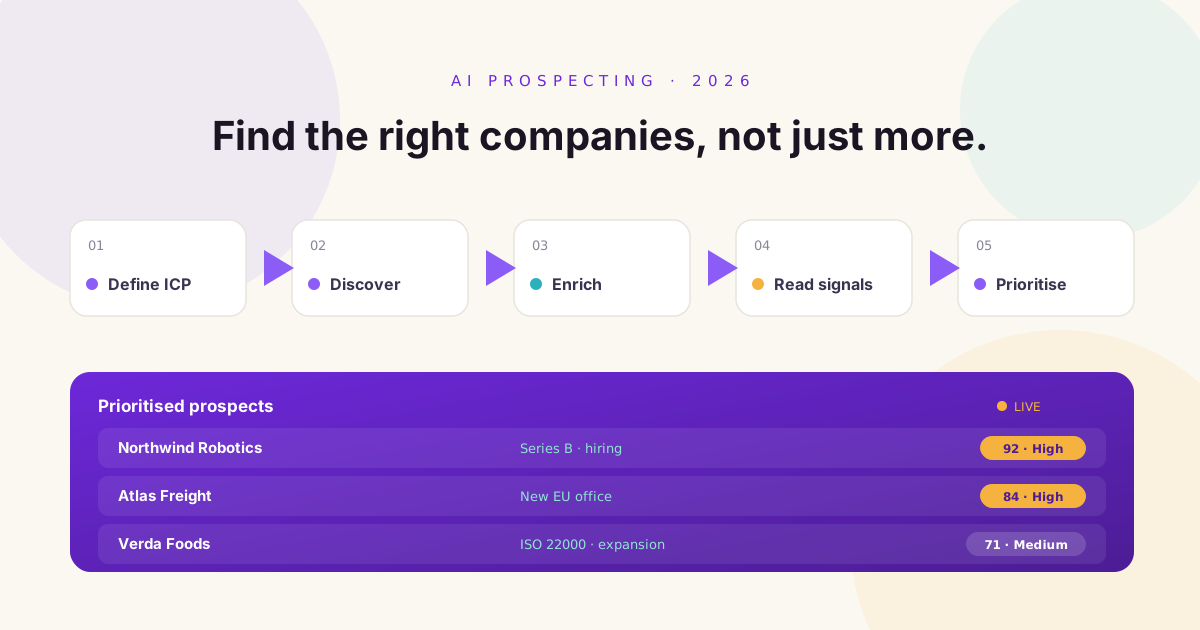
For years, B2B prospecting followed a familiar routine. A sales rep opened a database, chose a few filters, exported a list of companies, found some contacts, and started sending emails.
The workflow was simple. It also had real limits. The same databases were available to competitors. The same filters produced many of the same companies. Teams spent hours researching prospects by hand, and much of the information was outdated before it could be used.
AI prospecting changes that process. Today, AI can help revenue teams discover companies from a far wider range of sources, organise scattered information, enrich company records, spot relevant business activity, and prioritise prospects far more efficiently.
AI prospecting is often misunderstood. Many people assume it means asking a tool to write a cold email. That is only a small part of it. AI prospecting begins before the first message is written. It starts with understanding who you want to reach, finding companies that match that profile, and identifying the information that makes a prospect relevant.
This guide explains what AI prospecting is, how it works, where it creates value, and how B2B teams can use it to build a stronger pipeline.
What Is AI Prospecting?
AI prospecting is the use of artificial intelligence to support the work of finding, researching, qualifying, enriching, and prioritising potential customers. Depending on the platform, AI can help teams:
- Discover companies that match an Ideal Customer Profile
- Search public and industry specific data sources
- Extract information from websites and documents
- Organise unstructured business data
- Enrich company records
- Identify relevant decision makers
- Detect business signals
- Categorise and score prospects
- Suggest useful research angles
- Support more personalised outreach
- Keep prospect data current
The purpose is not to remove salespeople from the process. It is to reduce repetitive research and help teams make better prospecting decisions. A rep still needs to understand the customer's business, judge whether an opportunity is real, build trust, handle objections, and lead meaningful conversations. AI makes the research behind all of that faster and easier to scale.
AI Prospecting vs Traditional Prospecting
Traditional prospecting usually leans on commercial databases, manual web research, LinkedIn searches, spreadsheets, and individual effort. Those methods still have their place. The challenge is that they take time and often limit teams to the same shared data sources as everyone else.
AI widens what is possible. Instead of researching one company at a time from a narrow set of filters, teams can analyse companies at larger scale, pull from many public and niche sources, and keep the data continuously refreshed. In practice the shift looks like this:
- Manual company research becomes automated or assisted research
- A narrow set of sources becomes many public and niche sources
- Static prospect lists become continuously refreshed data
- Broad filters become ICP and signal based discovery
- Manual data cleaning becomes automated organisation
- One company at a time becomes larger scale analysis
One caution. AI does not automatically make a prospecting strategy better. A weak ICP still produces weak results. Poor data still leads to poor recommendations. Generic outreach stays generic, even when AI writes it. The quality of the strategy still matters.
Why AI Prospecting Matters Now
Modern sales teams face a hard combination of pressures. Prospects receive more outreach. Decision makers have less time. Shared databases create more overlap. Teams are asked to do more with fewer resources.
At the same time, valuable business information is spread across thousands of public sources: trade show exhibitor lists, government registries, certification directories, company websites, industry associations, supplier directories, procurement portals, business announcements, hiring pages, and public records.
The information exists. Finding and organising it by hand is slow. AI helps teams turn scattered information into structured prospect intelligence. That moves the question from 'Which companies appear in our database?' to 'Which companies match our ICP and show relevant business activity?'
The AI Prospecting Workflow
A strong AI prospecting process usually runs through several stages.
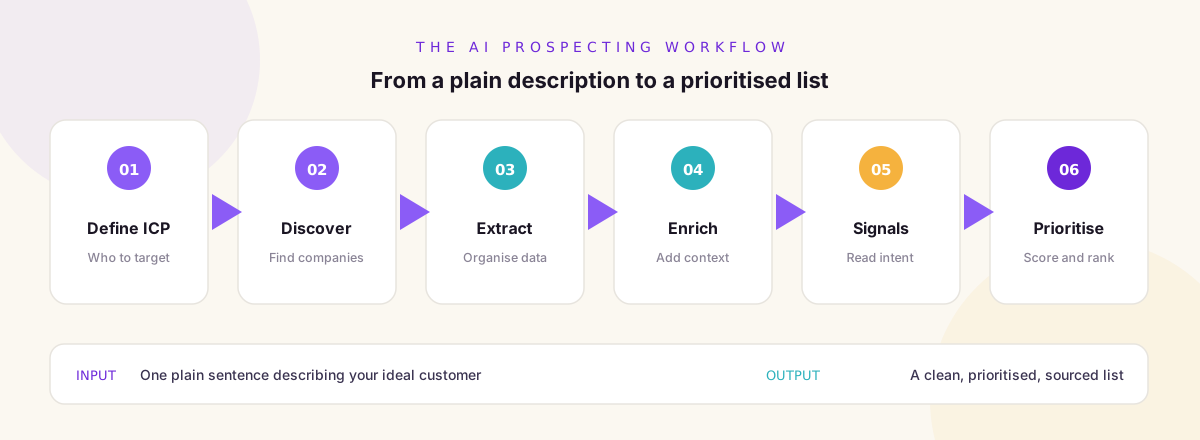
Step 1: Define Your Ideal Customer Profile
Before searching for prospects, define what a strong customer looks like. Your ICP might include industry, geography, company size, revenue range, business model, technology environment, operational traits, growth stage, relevant certifications, and common challenges.
For example: mid market food manufacturers in Europe with multiple production sites, international distribution, relevant food safety certifications, and recent operational expansion. That is far more useful than 'manufacturing companies'. A clear ICP gives AI a better framework for finding relevant businesses.
Step 2: Discover Companies from Relevant Sources
Once the ICP is defined, the next step is discovery. AI can support research across trade shows, government databases, industry directories, certification records, Google Maps, supplier lists, procurement portals, and company websites. The best source depends on the market. A company selling event technology may lean on exhibitor and conference data. A logistics provider may focus on import and export activity and warehouse expansion. A compliance platform may prioritise certification and regulatory information. No single source works for every business.
Step 3: Extract and Organise Company Data
Business information is often unstructured. A company name may sit in a PDF. An address may be listed on a website. A certification may appear in an online directory. AI can extract and organise that information into consistent fields such as company name, website, industry, country, employee range, description, a relevant business signal, the source, the signal date, and an ICP score. That creates a usable foundation for further research.
Step 4: Enrich Company and Contact Records
A company name alone is rarely enough for outreach. Teams usually need company size, revenue estimates, office locations, products and services, relevant technologies, decision makers, job titles, and business contact information. Enrichment adds context. It helps you judge whether a company is a strong fit and who is worth contacting.
Step 5: Identify Business Signals
Business signals are events or changes that suggest a company is growing, investing, or facing a new operational need. Common examples include raising funding, hiring quickly, opening a new office, expanding internationally, building a new facility, earning a certification, exhibiting at a trade show, launching a product, announcing a partnership, or publishing a procurement opportunity.
A signal does not guarantee a company is ready to buy. It provides useful context for prioritisation and research. A company opening a new facility may matter to a warehouse automation provider. A company hiring across several countries may matter to an international payroll platform. Always read the signal in relation to the product you sell.
AI Prospecting Is More Than AI Generated Emails
AI written outreach gets a lot of attention, but writing messages is only the final stage of a larger process. If the prospect is a poor fit, better wording will not fix it. A useful sequence looks like this:
- Define the right audience
- Discover relevant companies
- Validate ICP fit
- Identify useful business context
- Find the right people
- Develop a relevant outreach angle
- Write the message
The quality of the earlier stages shapes the quality of the final outreach. Good prospecting starts with good data.
How AI Supports Better Personalisation
Personalisation should create relevance, not just drop a company name into a template. Weak personalisation says 'I noticed your company is based in France.' That fact is easy to find and may not matter.
Stronger personalisation connects a business event to a likely challenge. For example: 'I noticed your company recently expanded distribution across Southern Europe. Businesses at that stage often face new challenges around inventory visibility and regional coordination.' The message is still a hypothesis. It should not claim to know the prospect's exact priorities, but it gives a relevant reason to start a conversation. AI can surface the context. A rep should still review it and make sure the message is accurate.
How to Prioritise Prospects with AI
Not every prospect deserves the same attention. AI can help categorise companies by ICP fit, company size, industry relevance, geographic fit, recent activity, number of relevant signals, and whether decision maker information is available.
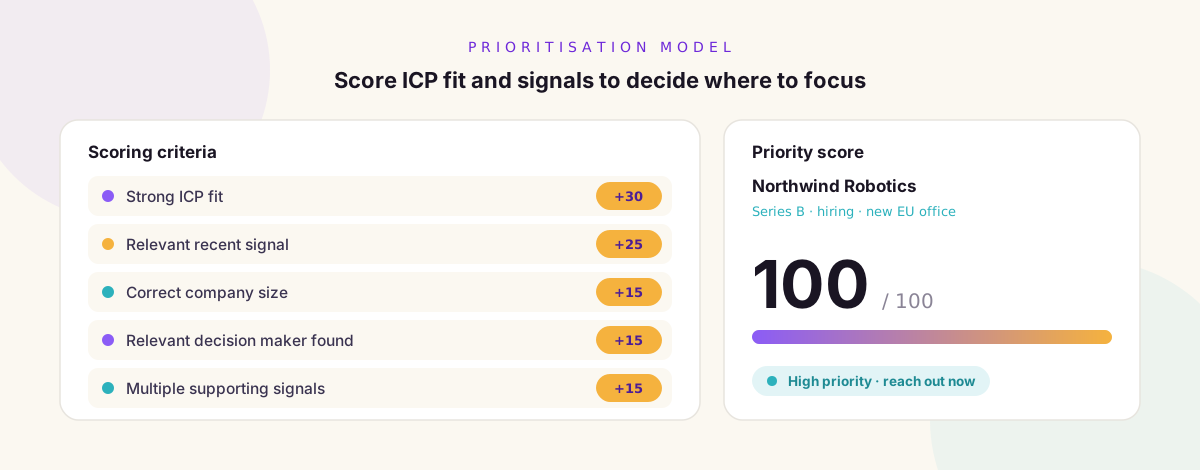
A simple scoring model might add points for a strong ICP fit, a relevant recent signal, the right company size, a relevant decision maker found, and multiple supporting signals. The score is not a prediction that a company will buy. It is a prioritisation tool that helps your team decide where to focus research and outreach first.
The Role of Custom Data in AI Prospecting
AI is powerful, but the data behind it matters. If every team uses the same commercial database, they keep discovering the same companies. Custom data creates a different starting point.
A custom prospect database can combine trade show data, government records, certifications, supplier directories, public tenders, hiring activity, expansion signals, company information, and contact enrichment. The advantage comes from combining information around a specific strategy. Instead of searching for 'all manufacturing companies with 200 to 500 employees', you might search for 'food manufacturers with ISO 22000 certification, international distribution, recent warehouse expansion, and more than 200 employees'. That is a far more specific opportunity.
Common AI Prospecting Mistakes
A few patterns show up again and again.
- Using AI without a clear ICP. AI cannot compensate for unclear targeting. Define the customer first.
- Treating AI output as automatically accurate. Review AI generated information, especially when it affects targeting or outreach.
- Automating too much. Fully automated outreach becomes repetitive and irrelevant. Keep human review where judgement matters.
- Focusing only on email generation. AI can support discovery, enrichment, research, and prioritisation, not just copywriting.
- Using only shared data sources. Commercial databases help, but they should not be the entire strategy.
- Confusing signals with guaranteed intent. A company that is hiring or expanding may be relevant. That does not prove it is actively buying.
- Ignoring data quality. Duplicate, outdated, or incomplete information reduces campaign effectiveness. Monitor quality continuously.
How to Measure AI Prospecting Performance
The goal is not simply more leads. Measure whether prospect quality improves. Useful metrics include the share of prospects matching the ICP, time spent researching each account, qualified meetings booked, meeting to opportunity conversion, opportunity to customer conversion, pipeline generated, sales cycle length, data accuracy, and cost per qualified opportunity.
Avoid judging the whole strategy on email open rates alone. A smaller campaign that creates more qualified opportunities can be far more valuable than a larger campaign with more activity.
A Practical AI Prospecting Example
Imagine a company selling cybersecurity software. A broad database search might target technology companies with 100 to 1,000 employees. That could return thousands of prospects.
An AI supported workflow could narrow the audience to companies that match the target industry, have more than 200 employees, recently expanded internationally, are hiring security professionals, opened new offices, and operate in regulated markets. The final list is smaller, but it carries far more context. The outreach can then focus on relevant business changes rather than generic company details.
Frequently Asked Questions
What is AI prospecting?
AI prospecting uses artificial intelligence to support company discovery, data extraction, enrichment, qualification, prioritisation, research, and outreach.
Is AI prospecting the same as AI lead generation?
They overlap, but AI prospecting usually covers a broader workflow, including research, qualification, enrichment, and prioritisation.
Can AI find new B2B companies?
AI can help discover companies across public and industry specific sources, depending on the platform, the available data, and your search criteria.
Will AI replace sales development representatives?
AI can automate repetitive research and data work, but human judgement, relationship building, and sales conversations remain essential.
How does AI improve personalisation?
AI can surface relevant company information and business activity. Sales teams use that context to craft more relevant outreach.
What data sources can AI use for prospecting?
Sources may include company websites, trade shows, government registries, certification directories, business listings, supplier databases, procurement portals, and other public information.
How does Kuration AI support AI prospecting?
Kuration AI helps teams build custom prospect databases around their ICP by discovering and organising company information from a wide range of public and specialised sources. Teams use relevant business characteristics and signals to build more targeted prospecting workflows.
The Future of AI Prospecting
The future of prospecting is unlikely to be about sending the highest volume of automated messages. It will be about understanding companies more effectively. The strongest teams will combine clear ICPs, high quality data, unique data sources, relevant business signals, AI assisted research, human judgement, and useful outreach.
AI makes it possible to process more information. Strategy decides whether that information creates value. The goal is not to automate every part of sales. It is to remove unnecessary research so teams can spend more time on meaningful conversations.
AI prospecting is not about finding more companies. It is about finding the right companies, and understanding why they may be relevant now.
Build a Smarter Prospecting Workflow with Kuration AI
Kuration AI helps revenue teams discover companies beyond standard shared databases. Build custom prospect databases from trade shows, government registries, certification directories, supplier lists, Google Maps, public records, procurement sources, and other high value data. Define your ICP, discover relevant companies, enrich business information, and prioritise prospects using meaningful context.