Most sales teams have no shortage of B2B buying signals. They have funding alerts, hiring alerts, news mentions, job changes, website visits and a feed of company updates nobody reads. What they do not have is a way to tell which of those signals means a budget exists and which one is simply a company existing in public.
That gap is why signal based prospecting so often disappoints. The problem is rarely a shortage of data. It is that every signal gets treated as equally meaningful, so the team either chases all of them or quietly ignores the lot. This article sets out a framework for classifying B2B buying signals by what they actually predict, how long they stay useful, and how much weight each one deserves.
Most Teams Collect Signals Without Classifying Them
Ask a revenue team what signals they track and you will usually get a list: funding, hiring, expansion, leadership changes, product launches, trade show attendance. Ask them what each signal means and the answers get vague. Funding means they have money. Hiring means they are growing. Expansion means opportunity.
Those answers are not wrong, but they are not decisions either. A signal that cannot change what you do next is trivia. The value of a signal comes from the specific action it justifies, and different signals justify very different actions.
A company that just closed a funding round and a company that just posted its first operations role are both interesting. They are not interesting in the same way, on the same timeline, or to the same person on your team. Treating them identically wastes the advantage that finding the signal gave you in the first place.
What a Buying Signal Actually Tells You
A buying signal is evidence that a company changed, and that the change might create a need for something you sell. Notice how much doubt is built into that sentence. Evidence, not proof. Might create, not will create.
This matters because signals are frequently sold as intent. They are not the same thing. Intent means someone is actively looking for what you sell. A signal means conditions have shifted in a way that makes looking more likely. The gap between those two states is where most wasted outbound lives.
Once you accept that a signal is probabilistic, the job changes. You stop asking whether a signal is real and start asking how much it should move a company up your list.
The Three Types of B2B Buying Signals
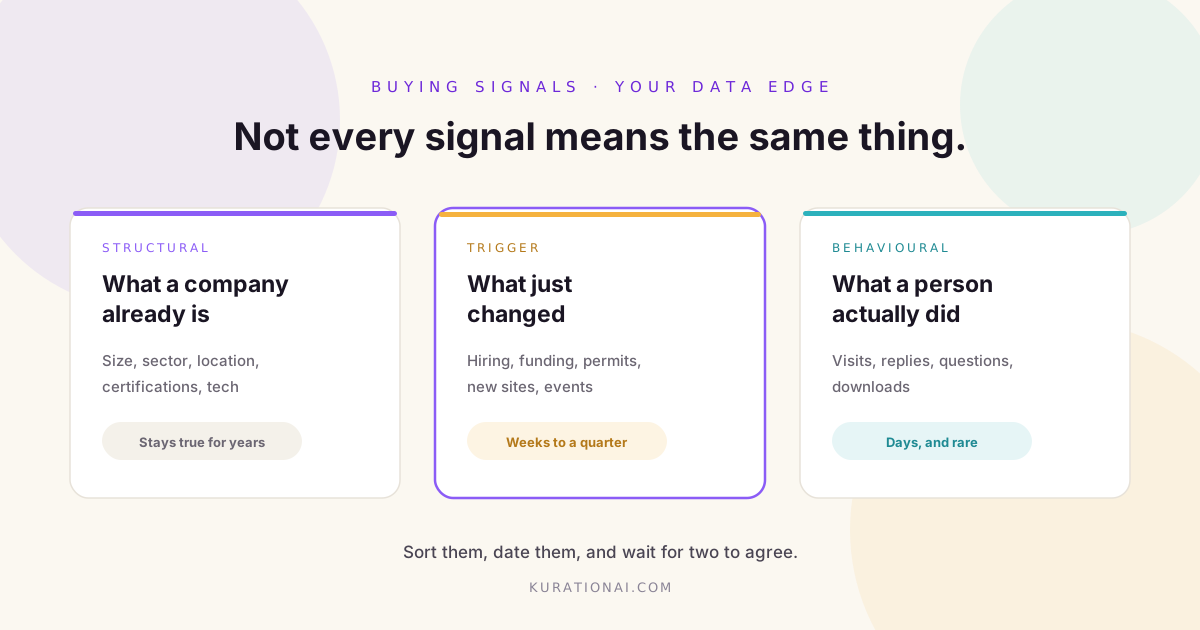
Almost every signal worth tracking falls into one of three categories. Sorting them this way is the single most useful thing you can do with a signal feed, because each category behaves differently and needs a different response.
Structural signals: what a company is
Structural signals describe a stable fact. Headcount, industry, location, revenue band, the technology on the website, whether the company holds a particular certification. These are the filters every database gives you.
Structural signals answer whether a company could ever be a customer. They are necessary and almost never urgent. A company that fits your profile today fitted it last quarter too, which is exactly why your competitors have already found it.
Trigger signals: what just changed
Trigger signals describe an event. A funding round, a new facility, a first hire in a new country, a certification granted, an acquisition, a new product line, a booth at a trade show the company has never attended before.
Trigger signals answer whether something is happening now. They carry timing information that structural data cannot, and timing is usually the scarce ingredient in outbound.
Behavioural signals: what someone did
Behavioural signals describe an action by a person, often toward you. Someone visited your pricing page, opened a sequence three times, downloaded a comparison, asked a question in a community, or followed your company page.
Behavioural signals are the closest thing to real intent, and they are also the rarest. Most companies that will buy from you this year have not done anything you can observe yet. Building a prospecting programme that only reacts to behaviour means waiting for a queue that stays short.
Why the Difference Matters for Outbound
The three categories fail in different ways, so mixing them hides problems.
A list built only on structural signals is accurate and crowded. Everyone with the same database and the same filters is looking at the same companies, and none of them can say why they are reaching out this week rather than any other week.
A list built only on behavioural signals is small and late. By the time somebody compares vendors on your website, they have usually spoken to two of your competitors already.
Trigger signals sit in the useful middle. They are far more numerous than behaviour and far more timely than structure. Most of the advantage in modern prospecting comes from finding trigger signals early and pairing them with a structural fit you already trust.
Every Signal Has a Half Life
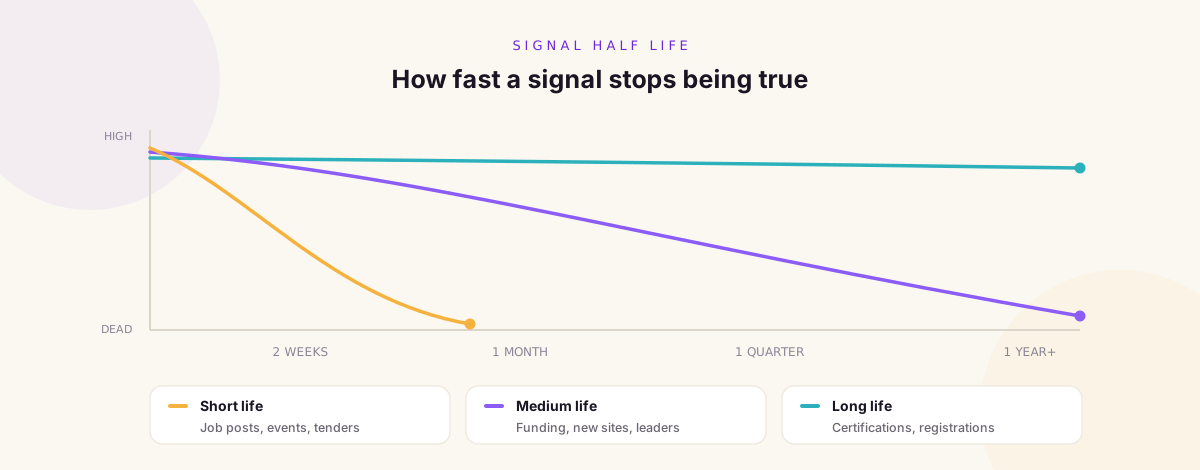
The second thing to record about a signal is how quickly it stops being true. A signal that was excellent six months ago can be actively misleading today, and most teams never build in an expiry date.
Short life signals
A job post that has been open two weeks, a booth at an event next month, a tender with a closing date. These decay in days or weeks. If you find them late, the moment has passed and someone else has already been in the room.
Medium life signals
A funding round, a new office, a leadership hire. These stay relevant for roughly one to two quarters, because the spending they imply happens over months rather than days. There is a real window, but it does close.
Long life signals
A certification, a licence, a registered entity in a new market, membership of a trade body. These stay true for years. They are excellent for qualification and almost useless for timing, so treat them as structure wearing the costume of an event.
Writing a half life next to every signal you collect prevents the most common failure in signal based outbound, which is emailing a company about something that stopped being news two quarters ago.
Strength Is Not the Same as Freshness
Two properties get confused constantly. Freshness is how recently the signal appeared. Strength is how much the signal implies a budget and an owner.
A press mention from this morning is fresh and weak. A tender award from last month is slightly older and much stronger, because it names a project, a value and a party responsible for delivering it.
When you score signals, keep the two numbers separate. Collapsing them into a single relevance figure is how a stream of recent but meaningless updates ends up outranking the handful of signals that actually predict spend.
The Corroboration Rule
One signal is a coincidence. Two signals pointing the same way inside a short window is a pattern worth acting on.
A company hiring a regional manager might be replacing somebody. A company hiring a regional manager, registering a local entity and booking a stand at a regional trade show inside ninety days is doing something deliberate, and somebody inside that company owns the plan.
Corroboration is the cheapest quality control available to a prospecting team, because it costs nothing except the discipline to wait for the second signal. It also fixes the biggest weakness of any single source, which is that any single source is occasionally wrong.
Scoring a Signal in Four Questions
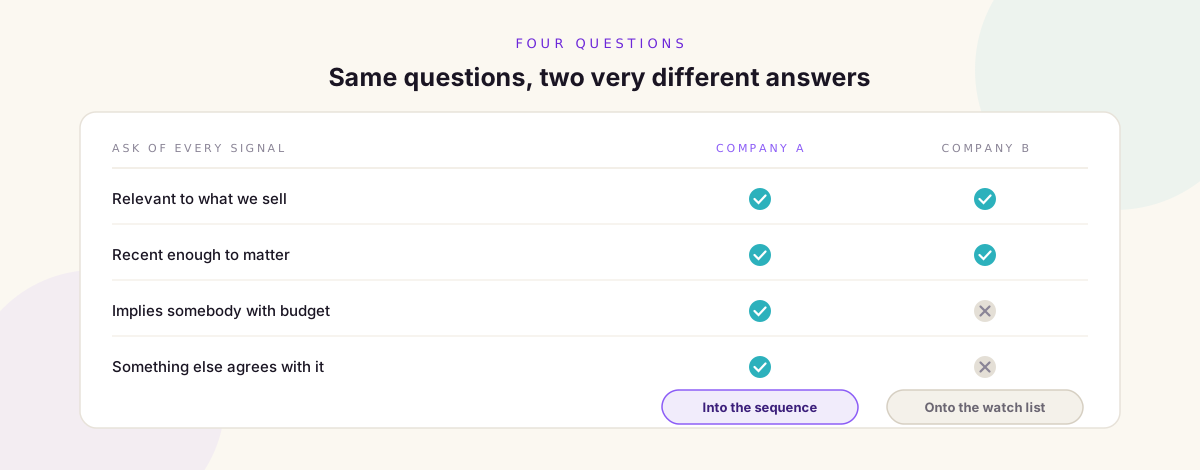
You do not need a complicated model. Four questions, answered honestly, will separate the signals worth acting on from the noise.
Is it relevant to what I sell?
Not interesting in general. Relevant to your product specifically. A funding round matters if your product costs money and helps companies grow. It matters far less if you sell into a function the round will not touch.
Is it recent enough to matter?
Compare the age of the signal against its half life. A three week old job post is fresh. A three week old trade show that already happened is not.
Does it imply somebody with budget?
The strongest signals name or imply a person who can spend. A new head of operations implies an operations budget. A generic company milestone implies nobody in particular.
Does anything else agree with it?
Look for a second, independent source pointing the same direction. If nothing else agrees, the company belongs on a watch list rather than in a sequence.
Where Each Signal Type Comes From
Signal types map onto different sources, which is why a team relying on one platform tends to see only one kind of signal.
- Structural signals come from company databases, websites, registries and certification bodies
- Trigger signals come from job boards, funding announcements, permits and tenders, event exhibitor lists, trade registries and company news
- Behavioural signals come from your own website, your sequences, your community and your CRM
The first group is widely available and therefore widely used. The second group is scattered across sources that are public but awkward, which is exactly why it stays underused and stays valuable. The third group is genuinely yours and cannot be bought.
What This Framework Changes in Practice
Once signals are classified, several decisions become obvious that were previously arguments.
- Structural signals decide who belongs on the list at all
- Trigger signals decide who moves to the top of it this week
- Behavioural signals decide who gets called rather than emailed
- Half life decides when a company quietly leaves the list again
That last point is the one most teams skip. A prospect list without expiry becomes a graveyard of stale reasons to reach out, and the quality of every campaign run against it degrades slowly enough that nobody notices.
A Worked Example
Suppose you sell warehouse automation software. A company appears in your feed with three facts attached. It holds a food safety certification, granted four years ago. It posted a role for a distribution centre manager eleven days ago. It registered a second facility address in filings last month.
The certification is a long life structural signal. It confirms the company is the type you sell to, and it tells you nothing about timing. The job post is a short life trigger signal, fresh, and it implies an operations budget holder. The second facility is a medium life trigger signal that corroborates the first one.
Two independent trigger signals inside a month, both pointing at physical expansion, against a company that already fits structurally. That company goes to the top of the list this week, and the outreach references the second facility rather than the certification, because the certification is not news to anybody who works there.
Common Mistakes When Working With Signals
- Treating every signal as intent, then blaming the copy when reply rates disappoint
- Collecting signals with no expiry date, so old events keep resurfacing as new opportunities
- Scoring on freshness alone, which promotes noisy sources over meaningful ones
- Acting on a single unusual signal without waiting for anything to corroborate it
- Mentioning the signal in the first line of an email in a way that sounds like surveillance rather than research
- Tracking signals nobody has connected to a specific action, so the feed becomes decoration
Where Kuration AI Fits
Kuration AI is built for the middle category, the trigger signals that live in public sources but are painful to collect by hand. It discovers companies from job boards, registries, certification bodies, event listings, permits and company websites, then enriches those companies with the structural data you need to qualify them and the contacts you need to reach them.
The result is a prospect database where every company arrives with a reason and a date attached, so the framework in this article has something to run on.
Frequently Asked Questions
What is a B2B buying signal?
A B2B buying signal is observable evidence that a company has changed in a way that could create demand for what you sell. It indicates that conditions have shifted, which is different from proving that somebody is actively shopping.
What is the difference between a buying signal and intent data?
Intent data suggests somebody is actively researching a purchase. A buying signal is broader and usually earlier, describing a change at the company such as funding, hiring or expansion that makes a purchase more likely later.
How many signals should a company have before I contact them?
As a working rule, two independent signals pointing the same way inside a short window is enough to justify outreach. A single signal is usually enough to justify watching a company, but not enough to justify a sequence.
How long does a buying signal stay useful?
It depends on the type. Job posts and event participation decay in weeks. Funding rounds and new facilities stay relevant for one to two quarters. Certifications and registrations stay true for years but carry almost no timing value.
Which buying signals are the strongest?
The strongest signals are the ones that imply both a budget and an owner. Tenders, funded projects, senior hires in a relevant function and new facilities tend to outperform general company news, because they point at somebody who is accountable for spending.
Can AI help track buying signals?
Yes. The difficulty with trigger signals is that they are spread across many public sources in inconsistent formats. AI is well suited to reading those sources at scale, extracting the company behind each mention, and keeping the result current.
Signals Are a Question, Not an Answer
The teams that get the most out of signal based prospecting are not the ones with the largest feed. They are the ones who decided in advance what each type of signal means, how long it stays true, and what happens when two of them agree.
A signal is a reason to look more closely at one company instead of a thousand. Treat it as the beginning of the research rather than the conclusion, and the same feed that produced noise last quarter starts producing conversations.
Build a Prospect Database Where Every Company Has a Reason
Kuration AI discovers companies from job boards, government registries, certifications, trade shows, permits and company websites, then enriches them with firmographics and verified contacts. Every record arrives with the signal that surfaced it and the date it appeared, so your team can prioritise on evidence instead of guesswork.