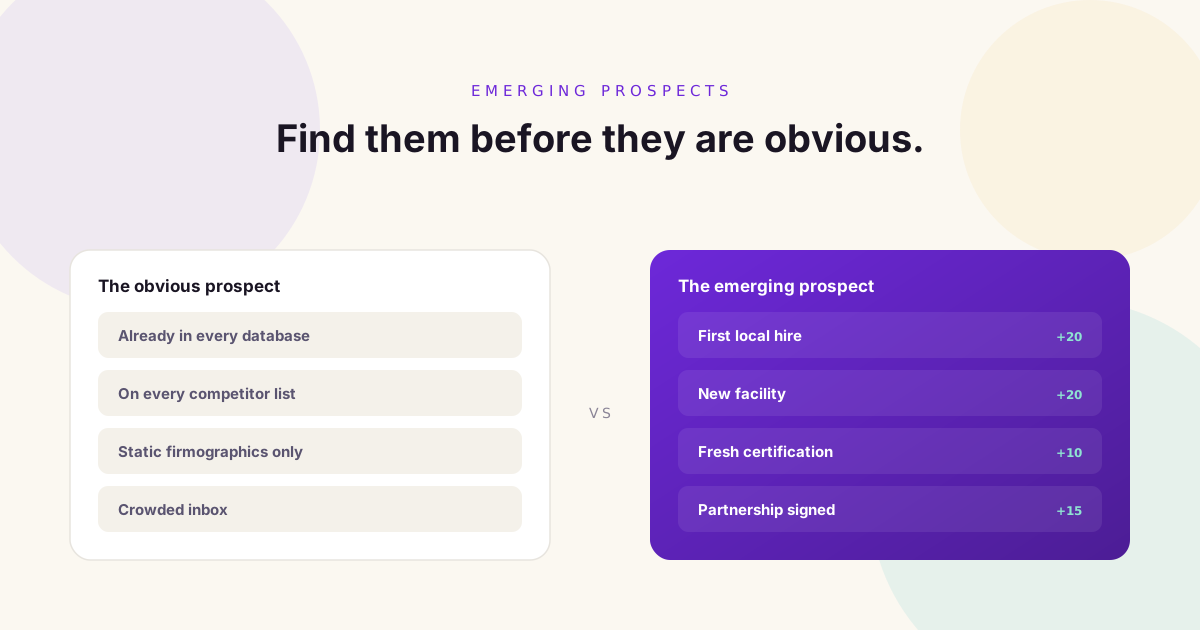
By the time a company appears on everyone's prospecting list, it may already be receiving everyone's outreach. That is the uncomfortable reality of modern B2B sales.
A company becomes successful. Its headcount grows. It raises funding. It expands into new markets. Its website gets bigger. Its executives become visible. And suddenly, every sales team using the same databases can find it. The company has gone from being relatively unknown to being an obvious prospect. That is when competition increases.
But there is another way to think about prospecting. What if you could identify the company while the signals were still emerging? Before it becomes a household name in your sales database. Before dozens of competitors have added it to their sequences. Before everyone knows that it is growing.
This does not mean predicting the future. It means paying attention to the information that appears before a company becomes an obvious prospect. And increasingly, AI can help sales teams do exactly that.
What Is an Obvious Prospect?
An obvious prospect is a company that clearly matches the criteria most sales teams use to build lists. It might have the right industry, the right employee count, the right revenue, the right location, a recognisable brand, a large sales team, and a visible online presence.
Finding these companies is easy. That is precisely the problem. If your competitors can apply the same filters and find the same companies, you are not creating much of a data advantage.
The opportunity is to look beyond those obvious characteristics. Instead of asking 'Which companies fit our ICP?', ask 'Which companies are becoming a better fit for our ICP?' That is a very different question.
The Signals Appear Before the Prospect Does
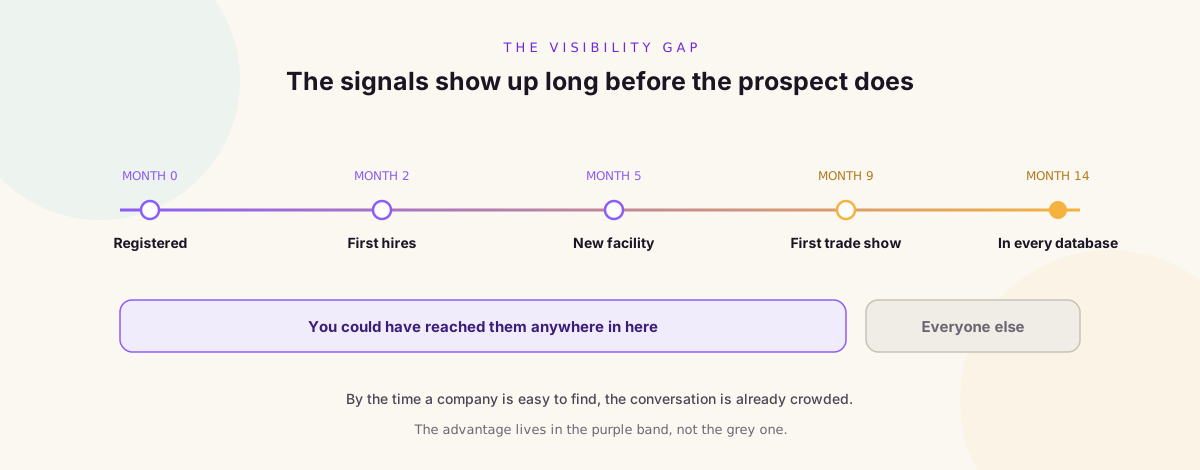
Companies do not suddenly become attractive prospects overnight. Their growth usually leaves clues. A business might:
- Hire its first sales team
- Open a new facility
- Raise funding
- Enter a new country
- Launch a new product
- Receive a certification
- Attend a major trade show
- Build a distribution network
- Start hiring for a new function
- Acquire another company
These events happen before a company's growth is fully reflected in traditional databases. That creates an opportunity. Instead of waiting for the database to catch up, you can look for the underlying signals.
Why Early Prospect Discovery Matters
Finding a company early does not guarantee that you will win it. But it can change the competitive environment. Consider two scenarios.
Scenario A: The Obvious Prospect
A company has 1,000 employees, major funding, a well known brand, hundreds of job openings, and a large sales department. Every competitor knows about it. The account may be valuable, but it is heavily targeted.
Scenario B: The Emerging Prospect
Another company has 150 employees, recent funding, rapid hiring, a new international office, and a recently launched product. It has not become a major name yet. But the underlying growth is already happening. That second company may offer an earlier opportunity to establish a relationship.
1. Look for New Company Registrations
One of the earliest signals is also one of the simplest. A new company has been created. Depending on your market, business registries can reveal newly registered companies, directors, business addresses, industry classifications, registration dates, and corporate structures.
Not every new company is a good prospect. Most will not be. But if your business sells services to startups, new manufacturers, franchisees, distributors, or newly established businesses, registration data can be extremely useful. The trick is combining registration information with your ICP.
2. Monitor Early Hiring Activity
Hiring is one of the clearest indicators that something is happening inside a company. A company that suddenly starts hiring for sales, operations, engineering, marketing, international business, or procurement may be entering a new stage of growth.
The type of role can be just as important as the number of openings. For example, imagine a company with no previous presence in Spain suddenly hiring a Country Manager for Spain, an Account Executive for Spain, and a Sales Development Representative for Spain. That is more interesting than simply seeing that the company is hiring. The roles provide context. They suggest the company may be building a sales operation in Spain.
3. Follow Funding, but Look Beyond the Announcement
Funding is a popular prospecting signal. But simply building a list of recently funded companies is not enough. The important question is what the company is likely to do with the new capital.
A funding announcement may mention plans to expand internationally, increase hiring, build new products, expand manufacturing, open offices, or invest in technology. Those details are much more useful than the funding amount alone.
Funding on its own is interesting. Funding plus international expansion is more interesting. Funding plus international expansion plus local hiring is very interesting. The context matters.
4. Watch for New Products
Product launches can reveal changing priorities. A company introducing a new product may need new suppliers, new distributors, new manufacturing capacity, new marketing support, new compliance services, new technology, or new sales infrastructure.
If your product supports one of those activities, the launch can become a useful prospecting signal. And again, timing matters. You do not necessarily want to wait six months until the company has become a major target. You want to identify the change when it begins.
5. Find Companies Attending Their First Major Trade Shows
Trade shows can reveal companies that are actively trying to gain market visibility. Look for first time exhibitors, new exhibitors in a region, new sponsors, new speakers, and companies appearing in new event categories.
A company exhibiting at a major industry event is investing time and money in being visible to a particular market. That can indicate commercial activity. It may be looking for buyers, distributors, partners, suppliers, or investors. The exhibitor list itself can therefore become a valuable prospecting dataset.
6. Monitor New Certifications
Certifications can provide another early signal. A company obtaining a new certification may be entering a regulated market, preparing to export, improving manufacturing standards, targeting new customers, or expanding its product range.
The certification does not tell you everything. But it can tell you something important about what the company is preparing to do. And when combined with other signals, it becomes much more valuable.
7. Look for New Facilities
A new facility can represent a major investment. Companies may announce new factories, warehouses, distribution centres, offices, or research facilities. These announcements can reveal expansion before the company's employee count or revenue data fully reflects it.
For businesses selling industrial equipment, logistics services, warehouse technology, security, construction services, ERP systems, or facility management, this can be an especially useful prospecting signal.
8. Look at Who Is Building Partnerships
Partnership announcements are often overlooked. A company may announce a partnership with a distributor, a reseller, a technology provider, a manufacturer, a regional partner, or a strategic supplier. This can reveal that the business is developing a new route to market.
For example, a European software company partnering with a distributor in Southeast Asia may be signalling a move into the region. The partnership itself may not be your sales opportunity. But the business change surrounding it might be.
9. Track Changes in Company Websites
Websites can reveal surprisingly useful information. Look for new country pages, new product pages, new languages, new industry pages, regional contact information, new distributor pages, and new careers pages.
A new localised website can be an early sign of international expansion. A new industry specific page can suggest a new target market. A new product section can reveal where the business is investing. The information is public. The challenge is finding it at scale.
10. Use Business Signals Together
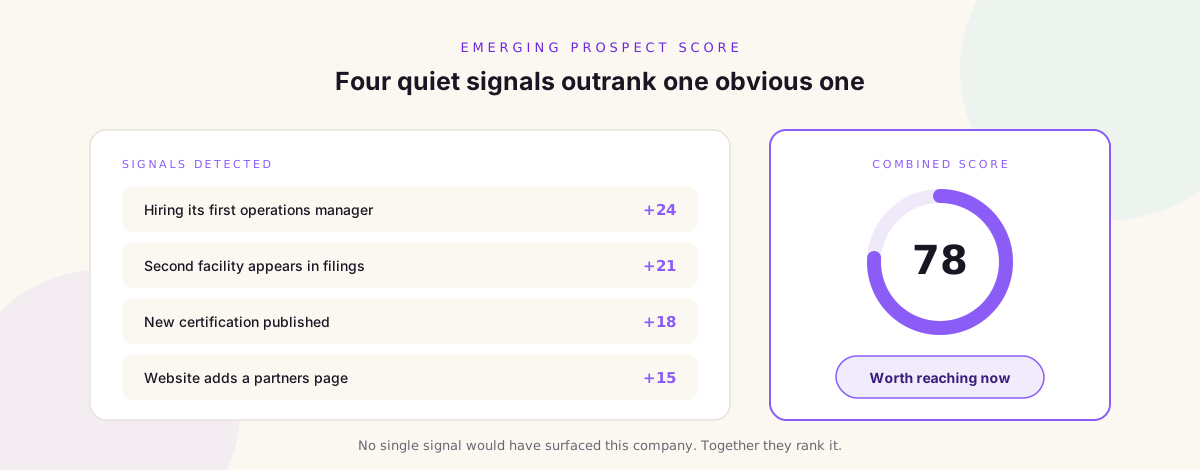
This is where things get interesting. You should not automatically treat every event as a prospect. Instead, combine signals. Imagine you discover a company that raised funding, started hiring salespeople, launched a new product, and opened a new country page.
Any one of those events could be relatively weak. Together, they tell a much stronger story. The company appears to be entering a growth phase. That may make it worth researching.
Create an Emerging Prospect Score
You can turn this idea into a simple scoring model. For example:
- Strong ICP fit: +30
- Recent funding: +15
- Rapid hiring: +20
- New market entry: +20
- New facility: +20
- New product: +15
- Relevant trade show: +10
- New certification: +10
A company does not need every signal. The purpose is simply to prioritise accounts that show multiple indicators of change. You can then divide prospects into groups:
- High priority: strong ICP fit plus multiple recent signals
- Medium priority: strong ICP fit plus one relevant signal
- Low priority: ICP fit but little evidence of recent activity
This gives sales a more useful way to allocate research time.
Where Can You Find Emerging Companies?
The information does not live in one place. That is part of the challenge. Useful sources can include:
- Government registries: new businesses, company structures, directors, locations
- Trade shows: emerging vendors, new market activity, exhibitors, sponsors
- Job boards: hiring growth, new departments, geographic expansion
- Certification databases: regulatory preparation, quality standards, export activity
- Company websites: product launches, new markets, new locations, partnerships
- Business news: funding, acquisitions, expansion, strategic announcements
- Procurement platforms: new contracts, tender activity, government opportunities
The value comes from connecting these sources.
Why Traditional Databases Miss Emerging Prospects
Traditional databases are generally designed to answer questions such as 'How many employees does this company have?' or 'What industry is this company in?' Those are useful questions. But they are mostly static.
Emerging prospecting asks different questions. What changed recently? Where is this company investing? What market is it entering? What is it building? What is it hiring for? What has it started doing that it was not doing before? These questions require a different type of data.
AI Makes This Approach More Scalable
This is where AI becomes particularly useful. A human researcher can investigate a handful of companies. But imagine trying to monitor thousands. AI can help process large amounts of information and identify patterns across different sources. Depending on the workflow, it can help:
- Discover companies
- Extract information
- Categorise businesses
- Identify changes
- Detect signals
- Enrich records
- Match companies to an ICP
- Score prospects
- Find relevant contacts
Instead of asking salespeople to manually investigate every company, AI can help surface the accounts that deserve their attention.
A Simple Emerging Prospect Workflow
Here is a practical process you can use.
- Define your ICP. Be specific about the companies you want.
- Define your signals. Identify the business events that could indicate opportunity.
- Select your sources. Find the public and specialised sources where those signals appear.
- Discover companies. Collect businesses that match your initial criteria.
- Enrich them. Add company and contact information.
- Identify recent changes. Look for events that happened recently.
- Score the companies. Prioritise accounts with strong ICP fit and multiple signals.
- Research before outreach. Understand what is actually happening inside the company.
- Reach out with context. Use the business change as a reason for the conversation.
What This Looks Like in Practice
Say you are selling warehouse technology. A traditional prospecting approach might search for manufacturers with more than 500 employees in Europe. That could return thousands of companies.
An emerging prospect approach might search for manufacturers that match your industry criteria, recently opened a warehouse, are hiring warehouse managers, are expanding production, and recently entered a new market. Now you have moved from 'Who could potentially buy?' to 'Who appears to be changing in a way that could make our solution relevant?' That is a much stronger starting point.
The Goal Is Not to Predict Who Will Buy
This distinction is important. Signal based prospecting is not fortune telling. You are not trying to say 'This company will definitely buy from us.' You are trying to say 'This company is showing characteristics that make it worth researching.' That distinction keeps your prospecting grounded. Signals help you prioritise. They do not replace qualification.
Do Not Abandon Traditional Databases
There is also no reason to throw traditional sales databases away. They can still be extremely useful for contact discovery, enrichment, company information, filtering, and verification. The opportunity is to use them as one layer of your prospecting strategy, rather than the entire strategy.
A stronger workflow might run from a unique data source to company discovery, then signal detection, then enrichment, then contact discovery, then qualification, then outreach. Each layer does something different.
Why This Creates a Data Advantage
If every competitor uses the same database, the database itself is not much of a competitive advantage. The advantage comes from finding information that others are not systematically using.
A company might be hidden inside an exhibitor list, a certification registry, a government database, a supplier directory, a procurement portal, or a local business listing. Finding that company is one thing. Connecting it to your ICP and identifying why it is relevant is another. That is where custom prospecting becomes powerful.
How Kuration AI Helps Find the Less Obvious Prospects
Kuration AI is built around the idea that your best prospects are not always sitting neatly inside a standard sales database. Revenue teams can use Kuration to discover companies across different sources and build custom prospect databases around their specific ICP.
That can include data from trade shows, government sources, certifications, supplier directories, Google Maps, public business information, and industry specific sources. The resulting data can then be enriched and organised so sales teams are not starting with a blank spreadsheet or a generic company list.
The goal is simple: find the companies that matter to your business, even when they are not obvious prospects yet.
Frequently Asked Questions
What is an emerging prospect?
An emerging prospect is a company that may not yet be an obvious sales target but is showing characteristics or business signals that suggest it could become relevant.
How can I find new B2B companies?
You can use company registries, trade shows, industry directories, government databases, business announcements, hiring data, certifications, and other specialised sources.
What are early prospecting signals?
Examples include funding, hiring, new facilities, international expansion, new certifications, partnerships, product launches, and trade show participation.
Is funding a good prospecting signal?
It can be. Funding becomes more useful when you understand what the company plans to do with the capital.
Can AI identify emerging prospects?
AI can help discover companies, process large amounts of business information, identify relevant signals, enrich records, and prioritise prospects.
Are emerging prospects better than established companies?
Not necessarily. Established companies can be excellent prospects too. The advantage of emerging prospect research is that it can uncover opportunities earlier and potentially reduce competition.
How does Kuration AI help with prospect discovery?
Kuration AI helps teams discover companies from a wide range of public and specialised data sources, then build and enrich prospect databases around their ICP and relevant business signals.
Find the Prospect Before Everyone Else Does
The easiest prospects to find are usually the ones everyone already knows about. They are already in the databases. They are already on competitor lists. They are already receiving outreach.
The harder and potentially more valuable work is finding the companies before they become obvious. That means looking beyond static company information and paying attention to change. A new hire. A new market. A new facility. A new certification. A new partnership. A new product. A new trade show.
None of these signals guarantees a sale. But together, they can tell you where a company is heading. And that can give your sales team something far more valuable than another generic lead list: a reason to start looking before everyone else does.
Build Your Own Prospecting Edge With Kuration AI
Kuration AI helps revenue teams discover companies beyond the standard database search. Find businesses through custom data sources, enrich them with relevant company and contact information, and identify the signals that make them worth pursuing. Do not wait for your next prospect to become obvious. Find them while the opportunity is still emerging.