Clay has carved out a strong position as a data enrichment and workflow builder for revenue teams. But it is not the right fit for everyone. Whether you find Clay too complex, too expensive at scale, or limited in the types of data it can surface, there are compelling alternatives worth evaluating in 2026.
This guide covers six Clay alternatives, each with different strengths. We break down what each tool does, what it costs, and where it excels or falls short so you can find the right fit for your workflow.
Why teams look for Clay alternatives
Clay is powerful, but its complexity is a double-edged sword. Common reasons teams explore alternatives include:
- Steep learning curve: Building Clay tables with enrichment waterfalls, AI prompts, and conditional logic takes weeks to master.
- Credit consumption: Costs escalate quickly when every lookup, AI call, and enrichment step burns credits.
- Enrichment-only scope: Clay enriches existing data but does not discover new prospects from unconventional sources.
- Overwhelming for small teams: Solo SDRs and lean teams often need simpler tools that deliver results without complex setup.
If any of these resonate, the alternatives below are worth a close look.
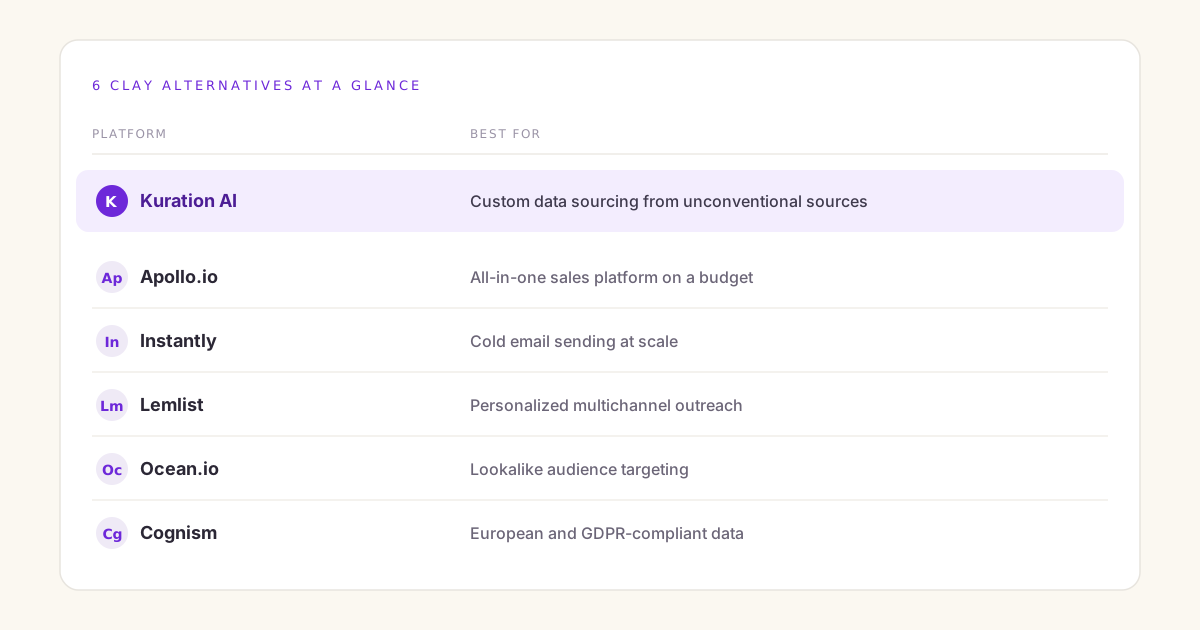
1. Kuration AI — Best for custom data sourcing from unconventional sources
Kuration is not an enrichment tool. It is a data sourcing platform that uses AI agents to discover prospects from sources no other tool covers: event sponsor pages, Google Maps, government business registries, PDF exhibitor lists, and trade directories.
Where Clay helps you enrich a list you already have, Kuration helps you build a list you could not get anywhere else. You describe your ideal prospect in natural language, and Kuration returns a structured, enriched dataset in under two minutes.
Pricing
Self-serve platform from $150/month. Autonomous Custom Database from $1,000/month. No annual commitment required.
Pros
- Finds prospects from sources no other tool accesses (events, maps, registries, PDFs).
- Conversational interface: no complex workflow building required.
- Delivers outreach-ready lists with verified emails and decision-maker contacts.
- Strong coverage in emerging markets and offline-heavy industries.
- Results in under two minutes from a natural-language prompt.
Cons
- Not designed for multi-step enrichment waterfalls like Clay.
- Smaller enrichment provider network compared to Clay's 75+ integrations.
- Best suited for prospecting and sourcing rather than complex data manipulation.
Best for
Teams that need to discover net-new prospects from niche, offline, or unconventional data sources. Ideal for event-driven prospecting, emerging market expansion, and industries with low digital footprints.
2. Apollo.io — Best all-in-one sales platform on a budget
Apollo combines a large B2B contact database with built-in email sequencing, a dialer, and basic CRM functionality. It is the closest thing to an all-in-one outbound tool and offers a generous free tier that makes it popular with startups and solo founders.
Pricing
Free plan available with limited credits. Paid plans from $49/month (Basic) to $119/month (Professional). Enterprise pricing on request.
Pros
- Large database of 270M+ contacts.
- Built-in email sequences and dialer.
- Generous free tier for getting started.
- Intent data and job change alerts on paid plans.
Cons
- Shared database: every Apollo user has access to the same contacts.
- Email accuracy rates vary, especially outside the US.
- No custom data sourcing from events, maps, or offline sources.
- Data can feel stale for less well-known companies.
Best for
Early-stage startups and solo SDRs who need a free or low-cost all-in-one tool for basic outbound prospecting in well-covered markets.
3. Instantly — Best for cold email sending at scale
Instantly is primarily a cold email sending platform with mailbox rotation, warmup, and deliverability features. It has added a lead database (Instantly B2B Leads) that lets users search and export contacts, making it a send-plus-source tool.
Pricing
Sending plans from $30/month. B2B Leads add-on from $47/month. Combined plans available.
Pros
- Excellent email warmup and deliverability features.
- Unlimited mailbox rotation on higher plans.
- Simple, focused UI for email campaigns.
- Affordable entry point for sending.
Cons
- Lead database is smaller and less mature than Apollo or ZoomInfo.
- No custom data sourcing capabilities.
- Limited enrichment features.
- Primarily a sending tool, not a data platform.
Best for
Teams that already have good data and need a reliable, affordable tool for sending cold email campaigns at scale with strong deliverability.
4. Lemlist — Best for personalized multichannel outreach
Lemlist combines email sequencing with LinkedIn outreach and calling in a single multichannel platform. It is known for its personalization features, including dynamic images and landing pages that insert prospect-specific details into your campaigns.
Pricing
Email Starter from $39/month. Multichannel Expert from $99/month. Enterprise pricing available.
Pros
- Strong multichannel capabilities: email, LinkedIn, and calling.
- Advanced personalization with dynamic images and custom landing pages.
- Built-in email warmup tool (lemwarm).
- B2B lead database included on higher plans.
Cons
- Lead database quality is inconsistent outside major markets.
- No custom data sourcing from offline or unconventional sources.
- Can be complex to set up multichannel sequences properly.
- Pricing adds up quickly when combining features.
Best for
Teams running sophisticated multichannel campaigns who want email, LinkedIn, and calling in a single tool with strong personalization features.
5. Ocean.io — Best for lookalike audience targeting
Ocean.io uses AI to analyze your best customers and find lookalike companies that match the same profile. Instead of filtering by firmographic criteria manually, you provide examples of ideal accounts and Ocean.io surfaces similar companies from its database.
Pricing
Plans from $52/month (Basic) to $249/month (Pro). Enterprise pricing on request.
Pros
- AI-driven lookalike modeling is genuinely useful for TAM expansion.
- Good at finding companies similar to your best existing customers.
- Clean interface with straightforward workflow.
- Useful for account-based marketing strategies.
Cons
- Relies on existing database coverage, so gaps remain in emerging markets.
- Contact data depth is limited compared to Apollo or ZoomInfo.
- Lookalike modeling works best when you already have clear customer patterns.
- No sourcing from events, maps, or offline data sources.
Best for
Marketing and sales teams with a well-defined ICP who want to expand their TAM by finding companies that resemble their best existing accounts.
6. Cognism — Best for European and GDPR-compliant data
Cognism is a B2B data provider with a strong focus on European markets and GDPR compliance. It offers phone-verified mobile numbers (Diamond Data) and has deep coverage across the UK, DACH, and Nordics that many US-centric tools lack.
Pricing
Pricing is not publicly listed. Contracts are typically annual and start around $15,000 to $25,000 per year depending on seats and credits.
Pros
- Excellent European data coverage, especially UK and DACH.
- Phone-verified mobile numbers with high connection rates.
- Strong GDPR and compliance framework with DNC list checking.
- Intent data powered by Bombora.
Cons
- Expensive: annual contracts with enterprise-level pricing.
- Shared database model means competitors access the same contacts.
- US coverage is less comprehensive than Apollo or ZoomInfo.
- No custom data sourcing from events, maps, or unconventional sources.
Best for
Enterprise sales teams focused on European markets who need GDPR-compliant data with phone-verified mobile numbers.
How to choose the right Clay alternative
The right tool depends on where your bottleneck sits:
- If you need to discover net-new prospects from unconventional sources: Kuration AI.
- If you need an affordable all-in-one outbound tool: Apollo.io.
- If you need to send cold email at scale with strong deliverability: Instantly.
- If you need personalized multichannel sequences: Lemlist.
- If you need AI-driven lookalike targeting: Ocean.io.
- If you need GDPR-compliant European data with verified mobiles: Cognism.
Most teams ultimately combine two or three tools. A common stack might use Kuration for sourcing proprietary prospect lists, Apollo or Cognism for additional contact enrichment, and Instantly or Lemlist for outreach execution.
The key question is not which tool is best in a vacuum. It is which tool fills the gap in your current workflow. If you already have data and need to enrich it, Clay and its competitors serve that purpose. If you need data your competitors cannot access, that is a fundamentally different problem, and it is the one Kuration was built to solve.